The Nomadic Standard: Mastering the Climate-Agnostic Wardrobe
The Nomadic Standard: Mastering the Climate-Agnostic Wardrobe
Today, social media is flooded with packing videos of people lugging five checked bags for a two-week holiday, just to ensure they have every possible accessory. But living out of a single suitcase you can actually carry for months on end? That is often the death of personal style.
When we moved out of our New York apartment and put our entire lives into a storage unit, we weren't just going on a trip; we were living in transit. We spent two months in Buenos Aires, test-driving the city for a potential move just as their spring was blossoming. It wasn't the blazing heat of summer - the evenings required layers, and sandals felt entirely out of place.
From there, the pendulum swung violently: we flew back to the States into a bitter -20°F windchill in the Washington D.C. area for apartment hunting, before finally thawing out in the 80-degree humidity of Florida.
Four climates. One suitcase. Zero compromises on our standard.
The Reality Check: Surviving the Extremes
Let me add a crucial caveat: there is a limit to the magic of layering. When we touched down in D.C. to face that -20°F windchill, no amount of cashmere or hopsack was going to cut it. We made a strategic pitstop at our storage unit to extract our heavy winter parkas, snow boots, thick scarves, hats, and gloves.
True style requires acknowledging reality - you dress for the elements; you don't stubbornly freeze in the name of fashion. But the beauty of the system was that beneath those heavy survival layers, our core travel capsule remained the foundation.
The Philosophy: Indexing for Experience
There is a misconception that packing well means packing your most expensive items. We rarely do.
Bags get compressed in overhead bins, and city streets are ruthless on footwear. We don't travel to sit in a hotel lobby and look pretty; we travel to experience the place. This means you have to index for comfort and durability. You leave the irreplaceable, delicate pieces in storage and pack the high-quality workhorses that can take a beating and still look impeccable.
When you strip away the luxury of a walk-in closet, you quickly discover the difference between "clothes" and "wardrobe architecture." Here is how we maintained the standard on the road, relying strictly on high-yield staples, strategic layers, and meticulous maintenance.
1. The Climate-Agnostic Staples
You cannot pack a coat for every season. You must pack pieces that adapt.
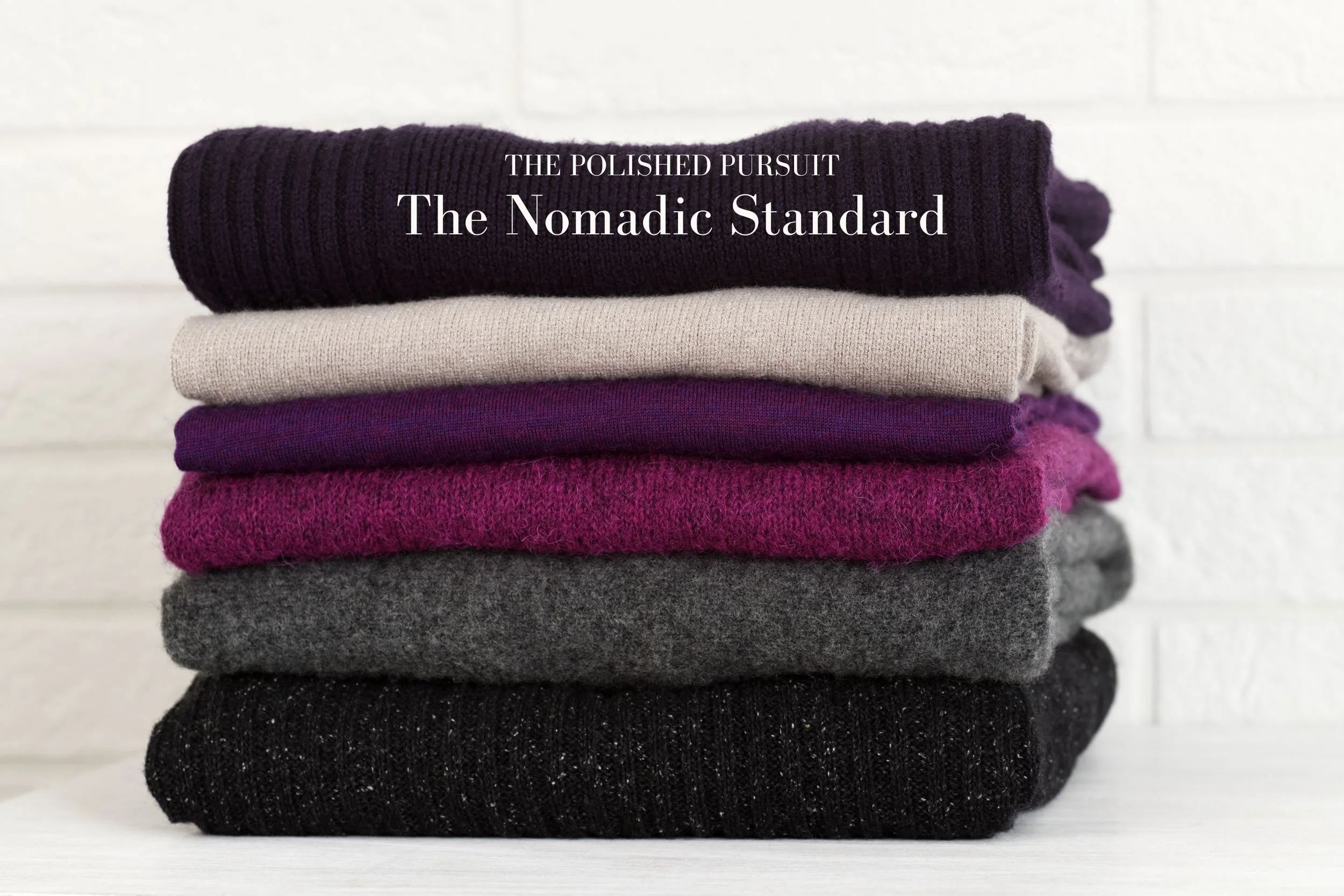
The Fine-Gauge Cashmere Turtleneck: This is the MVP of transitional travel. In the freezing D.C. wind, it is a crucial base layer under a heavy coat. In the brisk Buenos Aires evenings, it serves as an elegant top on its own. Cashmere regulates temperature naturally—it breathes when you are warm and traps heat when you are cold.
The Silk Carré: When you are repeating outfits, the silk scarf is your greatest asset. It weighs nothing and takes up zero space, yet it completely changes the geometry of an outfit. Tied tight around the neck, it blocks the biting wind; draped loosely over a sweater, it adds immediate evening polish.
The Leather Loafer: Spring in Argentina proved one thing: sandals are rarely the right answer for city walking. A structured leather loafer grounds an outfit while offering the necessary support for high-mileage days. Worn with thick socks in the snow or barefoot in the tropics, it maintains an executive silhouette no matter the latitude.
2. The Architecture: His & Hers Blazers
Leave the heavy tweeds and flimsy unlined linens behind. A great jacket is the anchor that pulls a travel capsule together.
For Her: The Oversized Silk/Wool Blazer. A blend of silk and wool offers the drape and slight sheen of an evening piece, but the durability of daywear. An oversized cut allows you to layer a thick cashmere sweater underneath it in the cold, or wear it effortlessly over a silk camisole in warmer weather.
For Him: The Structured Hopsack Blazer. Hopsack is a breathable, textured wool weave that naturally resists wrinkles. It is the ultimate travel fabric for men. It pulls together a simple t-shirt in Florida and layers beautifully over sweaters in the Northeast without looking stuffy.
3. The Travel Apothecary
Extreme climate shifting will destroy your skin barrier and wreck your hair. Your grooming standards cannot slip just because you are in a short-term rental.
The Lipid-Rich Moisturizer: Flight cabin air combined with freezing windchill strips the skin. I rely on a heavy-hitting, ceramide-rich cream that can be layered thickly at night in cold climates, or used sparingly as a spot treatment in humid ones.
The Packed Silk Pillowcase: Hotel cotton causes friction. Packing your own silk pillowcase takes up the space of a pocket square, but it preserves a blowout for days and prevents skin creasing. It is a non-negotiable travel staple.
The Universal Hair Oil: Humidity in Florida causes frizz; dry heat in D.C. causes static. A high-grade, weightless smoothing oil is the only product you need to tame both extremes.
4. The Secret Weapon: Maintenance
You can wear the same five shirts for a month and look like a millionaire—provided they are impeccably maintained.
This brings me to the ultimate travel hack: my husband, Ale. He happens to view laundry as a meditative practice and approaches ironing with the precision of a structural engineer.
When you travel with a capsule wardrobe, you are constantly washing and re-wearing. The difference between looking like a backpacker and looking polished comes down to the pressing. A crisp, flawlessly ironed collar on a basic cotton shirt will always look more expensive than a wrinkled designer blouse. We utilized irons religiously, kept our leather shoes polished, and never allowed a garment to look "lived out of."
Refinement isn't about having an endless closet. It is about demanding a high standard from the few pieces you carry with you.